



01
Presence & Duration
Automatically document that an employee entered a designated service area and how long the service visit lasted.
- Arrival and departure
- Time in area
- Location validation


Prove the work without asking people to prove it.
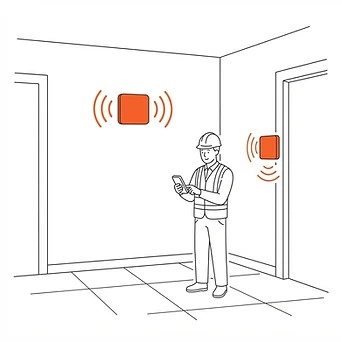
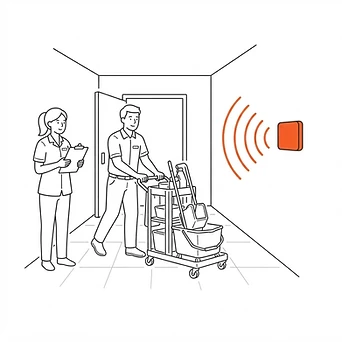
Proof of Presence automatically verifies that the right person reached the required location and captures when service started, when it ended, and how long the person was present—without QR codes, phones, paper logs, or manual check-ins.
Proof of presence is a verifiable record that a specific person was at a specific place at a specific time. For facility management and janitorial services, it documents attendance in a service zone, arrival, departure, and duration.
Contactless FM uses hands-free credentials and beacon-enabled zones to capture these records automatically. Building owners and building service contractors can compare recorded visits with service requirements and investigate missed visits or timing exceptions.
Presence and duration provide evidence of attendance, but do not by themselves prove that every cleaning task was completed or that quality standards were met. Connect occupancy-driven cleaning, Proof of Presence, and AI inspections to understand demand, response, and quality.
Manual check-in vs. hands-free
Every method below can produce a record. They differ in whether the worker has to stop working in order to create it.
| Compare | Manual check-in methods | Hands-free Proof of Presence |
|---|---|---|
| What the worker does | Stops work to find a phone, scan a code, tap a checkpoint, or sign a sheet. | Carries a credential and works normally; detection happens in the background. |
| When the record is created | Only when the worker remembers the step and completes it. | Automatically on entering and leaving each service zone. |
| What it captures | A timestamp at a single point, with no duration. | Arrival, departure, and time spent in the zone. |
| Where it works | Wherever the tag, code, or clipboard happens to be. | Indoors at room or zone level, which is where cleaning actually happens. |
| How reliable it is | Easy to skip, backfill, or lose. | Consistent, time-stamped, and audit-ready. |
| Privacy footprint | Phone-based tracking can follow a worker everywhere they go. | Presence is registered only inside defined service zones. |
Presence and duration are evidence of attendance. They are strongest when paired with occupancy data and quality inspections.
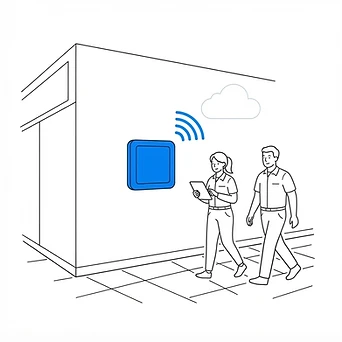
The employee works normally. The environment detects the service event, Contactless FM records it, and managers receive usable proof and exceptions instead of another manual task.
Conceptual system diagram. Exact hardware, communications path, and deployment configuration vary by facility.
Automatically document that an employee entered a designated service area and how long the service visit lasted.
Compare actual activity to required service and bring missed work or timing issues to a manager's attention.
Give owners, clients, and service teams a shared evidence base for contract performance and customer conversations.
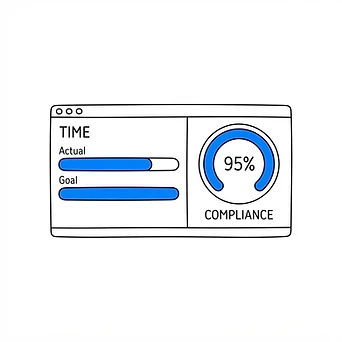
Proof of Presence records where a service visit occurred and how long it lasted. By measuring actual time-in-area against what each space requires, it surfaces the zones being skipped and the ones being over-serviced—so labor goes where the work is, not where the schedule assumes it is.
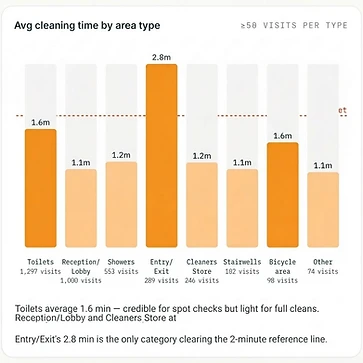
Proof of Presence doesn't just confirm a visit happened—it measures how long it lasted, providing evidence of service duration to review alongside quality inspections.
Across conference rooms, IT closets, restrooms, and open offices, the same beacon infrastructure detects staff, cleaners, and equipment—turning ordinary movement through the building into a verified record of who was where, when, and for how long.
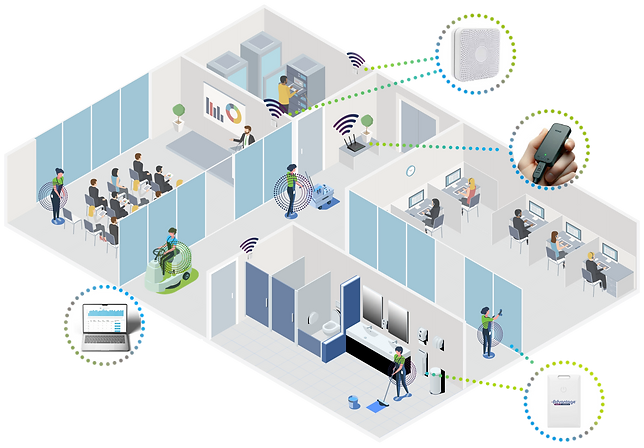
How Proof of Presence maps to the real facility. Wall-mounted beacons create detection zones around service areas; staff and cleaners carry hands-free Advantage tags that emit pulse rings as they move through the building. A handheld USB reader pairs tags at the point of service, a gateway routes events to Contactless FM, and the laptop dashboard surfaces presence, duration, and exceptions across every zone—so verified service replaces assumption in the conference room, the IT room, the restroom, and the open office alike.
Example monthly performance data: verified cleans per fixture per day, measured against a 4-visit-per-day standard. Underperforming floors—invisible on a paper log—stand out at a glance.
Illustrative example from a monthly Proof of Presence performance report.
See it in action
See exactly what Value-Based Cleaning™ reporting looks like—site grade, verified coverage, and floor-by-floor performance from a live building.
Proof of presence is a verifiable record that a specific person was at a specific place at a specific time. For facility management and janitorial services, it documents attendance in a service zone, arrival, departure, and duration.
No. The core Proof of Presence workflow is designed to validate service presence automatically without requiring a manual phone check-in, QR scan, or paper log.
The system can create a record of the employee or credential, the service zone, arrival, departure, duration, and whether required service conditions were met.
Occupancy can identify the need, Proof of Presence verifies the response, and AI Inspections can verify the final quality. Together they create the closed loop behind Value-Based Cleaning™.
QR codes require cleaners to stop working, pull out a phone, and scan—introducing friction and creating opportunities for missed or fraudulent check-ins. Hands-free beacon verification is automatic: the worker carries a credential and the system registers their presence as they enter each service zone, with no manual step.
GPS doesn't work reliably indoors, where most cleaning takes place. Beacons detect presence at the room or zone level inside buildings—exactly the granularity service verification needs. GPS also tracks employees everywhere they go, raising privacy concerns; beacons only register presence within defined service zones.
RFID wands and NFC tags require a deliberate physical tap at each checkpoint. If a worker is rushed, forgets, or skips a tap, the record is lost. Beacon-based Proof of Presence is fully passive—workers simply carry a credential and the system detects their arrival and departure automatically.
Paper logs are only as reliable as the person filling them out and can't be verified in real time. They're easy to backfill, lose, or misrepresent. Hands-free Proof of Presence creates an automatic, time-stamped digital record that reduces reliance on self-reported logs—giving building owners and BSCs evidence of attendance.
See how hands-free service verification can fit into one facility, one contract, or an enterprise cleaning program.
Pricing depends on the facility and deployment scope. The number of monitored areas, hardware and credentials, selected solution capabilities, connectivity, installation, training, and any integrations can affect the proposal. Request a facility-specific quote that separates initial deployment costs from recurring charges and states what support is included.
Implementation typically takes a few days to a week, depending on the size of the facility and the agreed scope. Larger facilities, multi-building sites, or campuses may take longer. We confirm the schedule after reviewing the areas to be monitored, site access, connectivity, and any required approvals.
The deployment plan covers the service areas and reporting goals, hardware placement and credentials, connectivity and site access, configuration, testing, and team orientation. Before handover, the project team checks that the agreed areas produce usable presence records and that managers can review the information. The exact steps depend on the solutions selected.
Share the facility type, approximate size, number of buildings and floors, areas to be monitored, service requirements, and the number of workers or credentials in scope. Floor plans, available connectivity, site-access requirements, and desired reporting or integrations help define coverage, cost, and timing.
Connectivity requirements depend on the hardware and deployment design. The site review confirms how devices and gateways collect and upload records, where coverage is available, and whether local network access or another agreed connection is needed. Update frequency is confirmed for the proposed configuration; continuous connectivity or real-time reporting should not be assumed for every site.
Yes. Contactless FM can support an existing building service contractor or in-house cleaning team. During implementation, the team agrees which service zones, schedules, and visit standards will be monitored and how managers will review exceptions. Presence records provide evidence of attendance and duration; quality inspections are needed to assess the cleaning result.
Integration requirements are reviewed during scoping. Identify the systems involved, the information to be exchanged, and the reporting or workflow you want to support. Compatibility, technical work, timing, and cost must be confirmed for the specific systems and configuration.
Agree what presence information will be collected, which service zones are monitored, who can access reports, and how long records will be retained. Employee communication and the organization's privacy and workplace policies should be reviewed before rollout. The core workflow verifies presence in configured service zones rather than requiring phone-based check-ins.
Start with the operational question: missed service visits, uncertain coverage, manual verification, or limited visibility into service delivery. Review the facility layout, service zones, workforce practices, connectivity, and reporting needs. Then define a measurable baseline and the outcomes to evaluate, such as visit compliance, service duration, or management time spent investigating exceptions.
A phased deployment can be discussed during scoping so priority buildings or service areas are addressed in a practical order. The plan should identify each phase's coverage, dependencies, validation, and handover. Larger facilities and campuses may require longer than the typical few-days-to-one-week implementation window.
Anonymous deployment stories
Results are reported by the technology provider or project team; see each story for context and limitations.
A commercial property used contactless service monitoring to identify cleaning-delivery gaps and improve measured compliance.
Read the anonymous case study →
