
Workplace Management
Smart Workplaces Don't Happen by Accident: Get IWMS Right From Day One.
October 30, 2026 · John Kunzier · 5 min read
Your workplace is too important for trial and error
Hybrid work, evolving employee expectations, and rising real estate costs have fundamentally changed how organizations think about their workplaces. Yet many companies continue to make critical space planning decisions using outdated assumptions, incomplete data, or disconnected systems.
The consequences can be significant: underutilized office space, overcrowded collaboration areas, inefficient parking allocation, and employees who struggle to find the resources they need.
That's why implementing an Integrated Workplace Management System (IWMS) shouldn't be treated as another IT project.
IWMS is an operational strategy—and one you need to get right the first time.
The objective isn't simply to deploy software. It's to establish a workplace operating model that supports employees, maximizes resources, and adapts as business needs change.
Start with strategy, not software
Before selecting an IWMS solution, organizations need to answer some fundamental questions:
- How are our workspaces actually being used?
- Are we allocating desks, meeting rooms, and parking based on real demand?
- Can employees easily access the spaces and resources they need?
- Do we have reliable data to support real estate and workplace investment decisions?
- Can our workplace management approach evolve as our organization grows or changes?
Without clear answers, even sophisticated technology can fall short.
A successful IWMS strategy begins with understanding how people work, identifying operational inefficiencies, and establishing measurable objectives. Technology should enable that strategy—not dictate it.
Ronspot: turning workplace strategy into everyday operations
Through its partnership with Ronspot, Invisible Sun Technology helps organizations move beyond traditional space management to create more flexible, efficient, and employee-friendly workplaces.
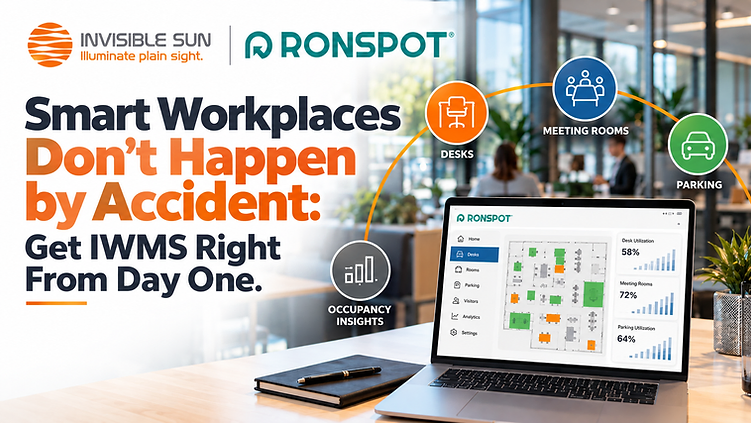
Ronspot's workplace management platform brings together essential resources in a unified experience.
- Desk management: Enable employees to reserve desks based on their schedules and workplace needs while giving managers greater visibility into space demand.
- Meeting room management: Simplify room reservations, reduce scheduling conflicts, and improve access to collaboration spaces.
- Parking management: Optimize limited parking resources through flexible reservations, allocation rules, and better visibility into availability.
- Automated workplace experiences: Capabilities such as DeskSync support automatic desk check-ins and releases, reducing manual processes and helping organizations make better use of available space.
- Access integration: GateLIFT extends workplace management to parking access, helping create a more seamless experience from arrival to departure.
Together, these capabilities help organizations establish consistent, scalable workplace operations rather than managing desks, rooms, and parking as separate challenges.
You can't optimize what you can't measure
One of the biggest mistakes organizations make is confusing reservations with actual utilization.
A booked desk doesn't necessarily mean someone used it. A reserved meeting room may sit empty. And attendance policies don't automatically translate into predictable occupancy.
That's where Invisible Sun Technology brings additional value.
By combining Ronspot's workplace management capabilities with Invisible Sun's occupancy measurement and Proof of Presence solutions, organizations can develop a more complete picture of workplace activity.
This combination helps leaders understand not only what employees planned to use, but how facilities are actually being occupied.
The result is better information for decisions about space allocation, workplace services, cleaning schedules, and future real estate requirements.
The difference is moving from managing reservations to managing workplace performance.
The cost of getting it wrong
An ineffective IWMS implementation can create problems that extend well beyond the initial technology investment.
Organizations may find themselves paying for space they don't need, investing in additional capacity while existing resources remain underused, or introducing processes that make the employee experience more complicated.
Worse, correcting these issues later can require new integrations, revised workflows, additional training, and organizational disruption.
Getting IWMS right the first time doesn't mean anticipating every future workplace change. It means building the right foundation: clear objectives, reliable data, integrated capabilities, intuitive employee experiences, and the flexibility to adapt.
That's the difference between buying workplace software and investing in a sustainable workplace strategy.
From workspace planning to workplace intelligence
The most effective workplace strategies don't stop at implementation.
They continuously use operational data to evaluate performance, anticipate changing demand, and improve how resources are allocated.
With Ronspot and Invisible Sun Technology, organizations can connect workplace planning with measurable operational outcomes—helping reduce wasted space, improve employee experiences, and make more informed investment decisions.
Whether an organization is implementing hybrid work, consolidating real estate, expanding operations, or simply trying to get more value from its existing facilities, the goal remains the same: the right space, for the right people, at the right time.
Get it right from day one
Your workplace is one of your organization's most significant investments. The systems used to manage it should be part of a deliberate operational strategy, not an afterthought.
Invisible Sun Technology and Ronspot help organizations establish that foundation by bringing workplace management, occupancy intelligence, and operational visibility together.
Because the best time to get your IWMS strategy right isn't after you've discovered what's not working. It's before you begin.
Ready to build a smarter workplace strategy? Visit Invisible Sun Technology to learn how Ronspot workplace management and occupancy intelligence can help your organization make better decisions from day one.
Invisible Sun Technology — Illuminate plain sight.
About the Author
John Kunzier
John Kunzier is CEO and co-founder of Invisible Sun Technology, the Doylestown, Pennsylvania company behind Contactless FM. With more than 38 years of experience across construction, engineering, service management, and technology, he has helped organizations ranging from local service providers to major real estate firms adopt technology that makes facility operations visible and measurable. He writes about Proof of Presence, occupancy intelligence, and the economics of clean.